Features
Tools, not just answers: your services in the agent's hands
Knowledge is for answering. Tools are for doing: reading an order's status from your shop, tracking a parcel, verifying a payment, recording a request.
The problem
A chatbot sends the link to the orders page. The customer who asked "where is my order" wanted an answer, not a link.
- 01
What connects today
Shops: WooCommerce, Sazito, Digify, Shopfa. Payments: Zarinpal. Data: Google Sheets and live search of your own site. Team and code: Slack and GitHub. Automation: n8n and a custom webhook. Eitaa too. Each has a page of its own; the rest sit in the directory with a "not yet" badge.
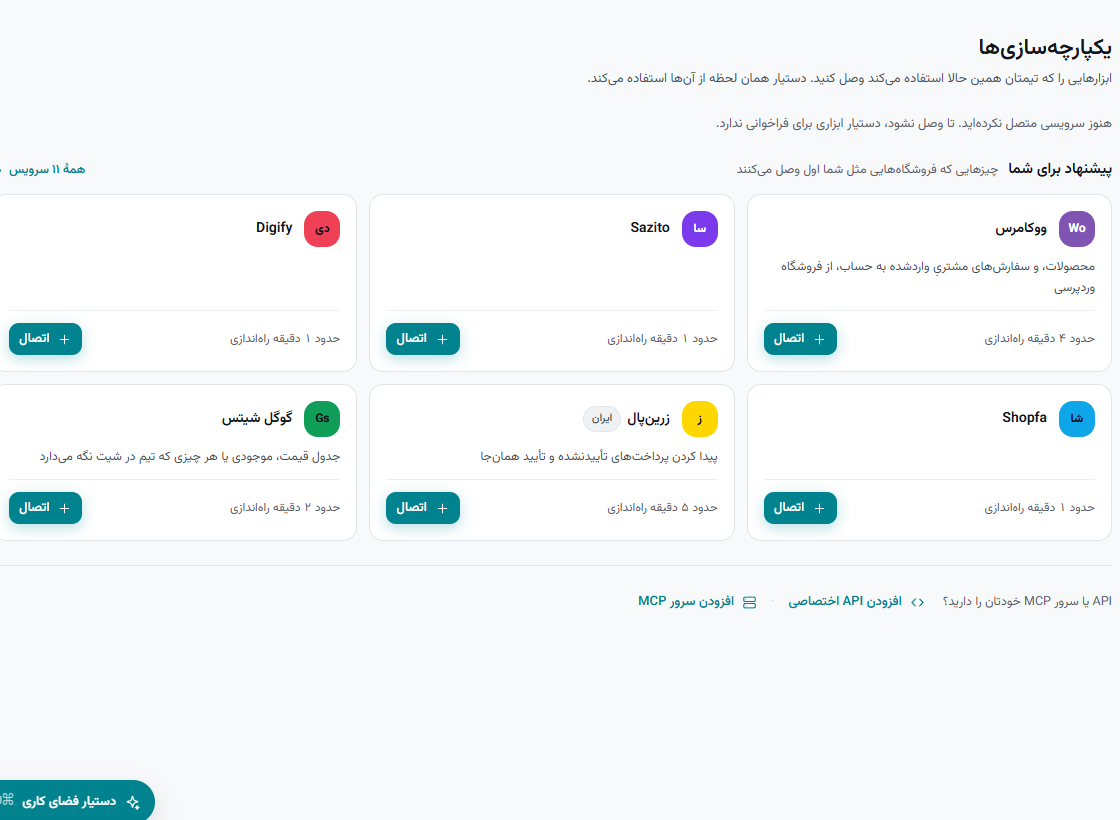
Integrations: channels above, services below; each with the tools it gives the agent. - 02
Your own API becomes a tool too
Paste an OpenAPI document or a curl command and its calls become tools. Keys stay encrypted and the agent never sees them. Same for an MCP server.
- 03
A tool is on, or it does not exist
Per agent, you tick each tool or not. An unticked tool does not exist for the agent. Every call, with its input and result, is logged in the conversation's trace.
- 04
What a person must do becomes a task
Returns, address changes, cancellations: instead of happening automatically, they are recorded for the team, and the customer is told it was recorded.
Typical chatbot
"Follow this link to see your order."
goya24
It finds the order in your shop itself and says what state it is in.
The rest of the product
Your first agent is ten minutes away
Free while you evaluate. Bring your own model keys if you'd rather.